A Modern Playbook for Responding to RFPs
Learn how to build a repeatable RFP response process that helps you win more bids. This framework covers qualification, proposal building, and post-mortem analysis to turn proposals into predictable revenue.
A Modern Playbook for Responding to RFPs
Responding to an RFP isn't just another administrative task—it's a high-stakes sales play. To win consistently, you need a repeatable game plan for deciding which bids are worth your time, how to craft a story that resonates with the client, and what you can learn from every submission to get better. This framework is all about investing your resources where they'll make the biggest impact, turning proposals into a predictable source of revenue.
The Strategic Lifecycle of Responding to RFPs
Winning more bids means ditching the reactive, last-minute scramble. So many teams I've seen treat every RFP like a fire drill, which just leads to burnout, inconsistent quality, and a win rate that goes nowhere. The real secret is to treat the entire effort as a continuous cycle with clear, manageable phases. When you get methodical, every proposal stops being just a document and becomes a powerful sales tool designed to persuade and win.
This flowchart breaks down the entire journey into three simple but powerful stages.
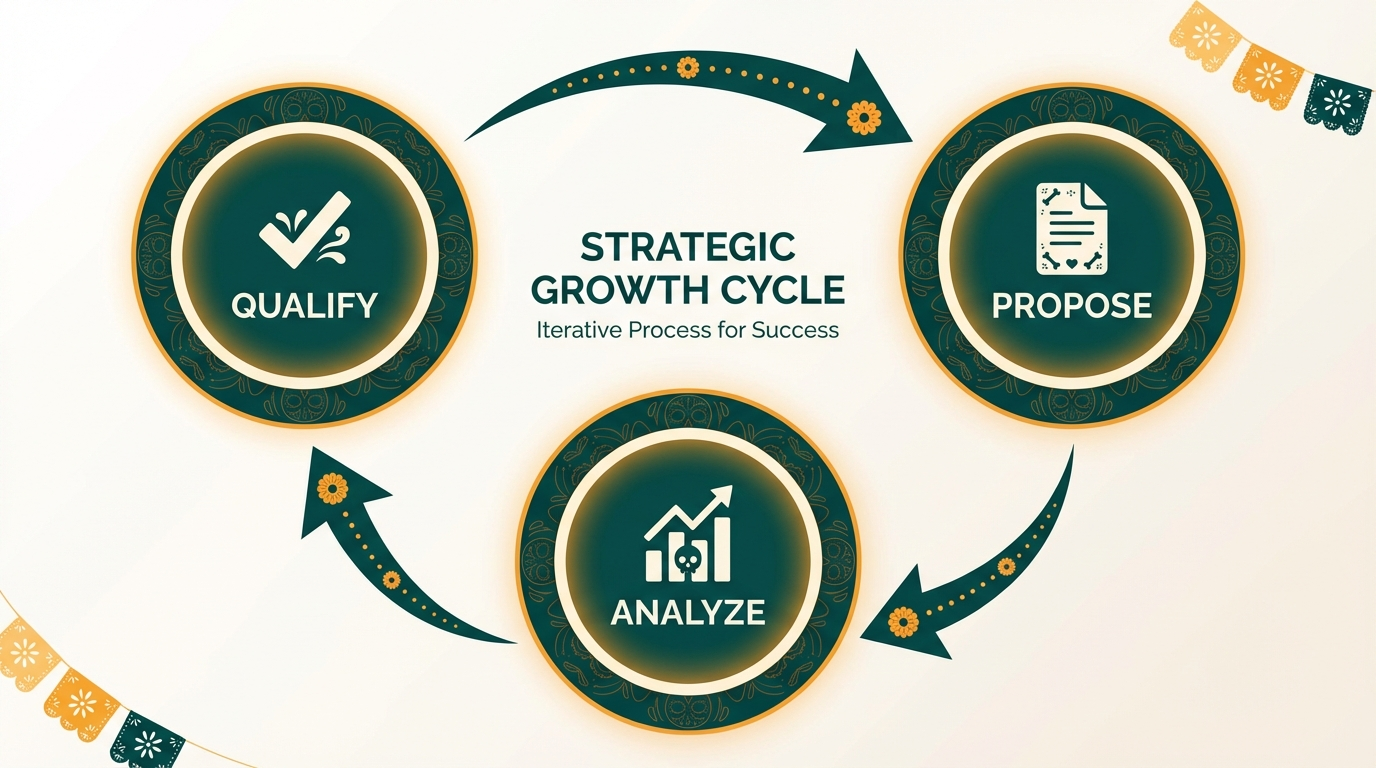
It's a straightforward loop: qualify the opportunity, build a compelling proposal, and analyze the outcome to get smarter for next time.
Building a Repeatable and Scalable Process
The first step, qualification, is where most of the magic happens. Honestly, it's the most critical part of the process. This is where you pull out your go/no-go checklist and get real about whether an opportunity is a good fit. Chasing everything that comes in the door is a classic mistake that just spreads your best people too thin. Be ruthless here.
Once you've decided to go for it, you enter the proposal phase. This is all about execution. You'll pull together your A-team—subject matter experts, sales leads, and writers—to build the actual response. A winning proposal is so much more than a list of features; it tells a story that connects your solution directly to the client's biggest headaches. It has to be persuasive, customized, and follow every single submission rule to the letter.
Finally, you hit the analysis phase, which closes the loop. It doesn't matter if you win or lose; you have to do a post-mortem. This is your chance to figure out what worked, what fell flat, and how you can sharpen your approach. That feedback gets fed right back into your process, making your content library stronger and your strategy smarter for the next bid.
A common mistake is viewing an RFP response as a one-off project. The best teams see it as a cycle. Every loss is a lesson, and every win provides a template for future success.
This structured approach transforms your efforts from guesswork into a well-oiled machine. A disciplined process is what separates the best from the rest.
The Strategic RFP Response Lifecycle
To make this crystal clear, here's a breakdown of the entire lifecycle, showing what happens in each phase and who needs to be at the table.
| Phase | Primary Goal | Key Personnel Involved | | :--- | :--- | :--- | | 1. Intake & Qualify | Determine if the opportunity is a good fit and worth pursuing based on a go/no-go framework. | Sales/Account Executive, Bid Manager, Sales Leadership | | 2. Propose & Build | Create a compelling, compliant, and client-focused response that showcases your value. | Proposal Manager, SMEs, Technical Writers, Sales, Legal | | 3. Analyze & Improve | Review the outcome (win or lose) to identify lessons learned and refine the process for future bids. | Entire Proposal Team, Sales Leadership, Product/Service Teams |
Thinking about your RFP responses in these distinct phases helps bring order to the chaos and ensures every submission is a strategic, calculated move.
It's a numbers game, after all. The average RFP win rate for organizations globally is 45%. Digging deeper, larger companies tend to hit 47%, while smaller businesses often lag behind at 42%. A disciplined lifecycle helps close that gap by ensuring every proposal you send is a solid investment.
Building Your Go/No-Go Decision Framework
The most critical decision you'll make in the entire RFP process happens before you even think about writing. It's the simple choice of whether to pursue the opportunity at all.
Chasing every RFP that lands in your inbox is a fast track to burning out your team, producing sloppy proposals, and tanking your win rate. A disciplined "go/no-go" framework isn't about being negative; it's about being ruthlessly strategic.
Think of it as a filter. It ensures you only pour your team's precious time and energy into bids you actually have a shot at winning. Without a framework, you're just gambling. With one, you're making calculated business decisions that directly improve your bottom line.
Key Evaluation Pillars
A solid go/no-go decision isn't just about whether you can do the work. The real question is whether you should. You need to look at the opportunity from a few different angles to move beyond gut feelings and score it objectively.
Your evaluation should always cover these core areas:
- Strategic Alignment: Does this client and this specific project align with where our company is headed? A huge logo in a new market might be worth the long odds.
- Relationship Strength: Do we know anyone there? Having an existing relationship or a friendly face on the inside makes a world of difference. A "cold" RFP is always an uphill battle.
- Solution Fit: Can we meet 100% of the mandatory requirements? In the black-and-white world of procurement, meeting 80% of the must-haves is often the same as meeting 0%.
- Competitive Landscape: Who else is at the table? If you know the incumbent is bidding or that a competitor is already deeply embedded, your odds drop significantly.
The point of a go/no-go isn't to find excuses to say no. It's to build a rock-solid business case for saying yes. When you decide to move forward, you do it with the confidence that it's a worthy investment.
Creating a Practical Scoring System
To take the emotion and bias out of the picture, you need a simple scoring system. This is how you turn abstract ideas into cold, hard data. Just create a scorecard that assigns points to your key criteria.
Let me give you a real-world example. A mid-sized SaaS company gets an RFP from a Fortune 500 giant. On the surface, it's a dream deal.
- The Gut Reaction: "This is huge! We have to go for it!"
- The Framework in Action: The team puts it through their scorecard. They have no prior relationship (-5 points). They can only meet 90% of the mandatory security requirements (-10 points). They also know the incumbent is a major competitor who is sure to bid (-5 points).
Even with the massive potential revenue, the final score was dismally low. They made the tough—but smart—call to "no-go," saving themselves hundreds of hours of work. That decision freed them up to win two smaller, higher-probability deals the very next month.
Beyond the Scorecard
While a scoring system is your foundation, don't forget the most practical element: resource availability. A perfect-fit RFP is an immediate "no-go" if your A-team is already buried in other projects.
You have to ask these down-to-earth questions:
- Do our subject matter experts actually have the time to provide quality input?
- Can our proposal manager give this the focus it needs without other deadlines imploding?
- Is the submission deadline even realistic for us to create a polished, winning proposal?
Saying "no" to a good opportunity because you just don't have the people-power is one of the most strategic moves you can make. It protects the quality of your current work and prevents you from submitting a rushed, half-baked proposal that could tarnish your brand. Responding to RFPs is a resource-intensive game; a go/no-go framework is how you play to win.
Assembling Your Proposal A-Team
Let's be honest: responding to an RFP is a team sport, not a solo mission. I've seen too many deals fall apart because one person tried to be the hero or a disorganized group threw something together at the last minute. A winning proposal is a carefully coordinated effort that brings together the right skills and perspectives.
Building your A-team isn't just about assigning tasks. It's about defining who owns what, getting everyone to collaborate, and creating a workflow that doesn't buckle under the pressure of a tight deadline. When everyone knows their part, the entire process runs smoother, and the final proposal is infinitely stronger.

Defining Your Core Players
While every company is different, most winning proposal teams are built around a few essential roles. These folks are the backbone of your response effort, and each brings a critical piece to the puzzle. Think of it less as a rigid hierarchy and more as a collaborative hub.
Your core players usually include:
- The Proposal Manager: This is your quarterback. They own the timeline, coordinate all the moving parts, chase down answers, and make sure the final submission is compliant and polished. They're the project manager of the entire operation.
- The Sales Lead (or Account Executive): The sales lead is the voice of the customer. They're the ones who truly understand the client's pain points, the competitive landscape, and the strategic story we need to tell to win.
- Subject Matter Experts (SMEs): These are your product and technical gurus. SMEs provide the detailed, accurate content for the nitty-gritty sections, answering complex questions about your solution's features, security, or implementation.
- The Legal/Compliance Team: Your safety net. They scan the RFP for contractual red flags, make sure your pricing and terms are sound, and give the final sign-off before you commit to anything in writing.
This structure prevents the all-too-common scenario where the sales rep is left scrambling to pull everything together with hours to spare.
Putting the Team into Action
Let's walk through a real-world example. A promising RFP for a complex software implementation lands in your inbox. The first thing the Proposal Manager does is schedule a kickoff call.
On that call, the Sales Lead doesn't just talk about the opportunity; they explain the why. The client isn't just buying software; they're trying to slash their operational costs by 20%. Suddenly, the context changes everything. Now, the SMEs aren't just rattling off features; they're connecting those features directly to cost reduction.
The Proposal Manager then maps out a project plan with clear deadlines for each section. The security SME gets the data integration questionnaire, while the product marketing SME starts on the user adoption and training sections. In the background, the Legal team is already red-lining the Master Service Agreement attached to the RFP. This way, everything happens in parallel, not in a frantic, sequential rush.
The goal is to move from a chaotic, last-minute scramble to a smooth, parallel workflow. A well-defined team turns the stressful crunch of an RFP into a manageable, strategic exercise.
Get Crystal Clear with a RACI Chart
To kill any confusion about who does what, a simple RACI chart is your best friend. RACI stands for Responsible, Accountable, Consulted, and Informed, and it creates a dead-simple matrix of roles and deliverables.
Here's what that might look like for a typical proposal:
| Task / Deliverable | Proposal Manager | Sales Lead | SME | Legal Team | | :--- | :--- | :--- | :--- | :--- | | Go/No-Go Decision | R | A | C | I | | Drafting Technical Answers | C | I | R | I | | Writing Executive Summary | R | A | C | I | | Pricing and Commercials | C | R | I | A | | Final Compliance Review | A | I | I | R |
This simple grid makes ownership clear as day. The person Responsible (R) does the work. The person Accountable (A) owns the final outcome. Those Consulted (C) give their input, and those Informed (I) are kept in the loop. No more bottlenecks or things falling through the cracks.
This isn't just about making life easier; it's about protecting revenue. The time it takes to respond is a serious investment—tech teams average 25 hours and healthcare teams 27 hours per proposal. When RFPs account for 39% of total company revenue worldwide, you can't afford to be disorganized, especially when 20% of all RFP efforts go unfinished.
Crafting a Compelling, Client-Centric Narrative
Look, anyone can fill out an RFP by just answering the questions. That's the bare minimum. It gets you in the door, but it almost never gets you the deal.
Winning proposals do something different. They transform a dry Q&A document into a compelling story—a narrative that positions your solution as the only one that truly makes sense for the client. This means you have to stop talking about yourself and start living in their world. Your real goal is to prove you get their business problems, not just that you can tick off a list of technical requirements.
When you nail this, you're not just a vendor anymore. You're a strategic partner.

Uncovering the Story Behind the Requirements
Every single requirement listed in that RFP has a "why" behind it. Your mission is to figure it out. A request for "real-time analytics dashboards" isn't just a technical bullet point. It's a cry for help. It probably signals a much deeper pain, like being unable to make fast, data-driven decisions while competitors eat their lunch.
Read between the lines to find this story. Look for recurring words, themes, and goals mentioned in the RFP's introduction or background. Are they obsessed with cutting operational costs? Boosting customer satisfaction? Getting to market faster? Each of these goals needs a completely different narrative.
Let's get practical. Imagine an RFP asks: "Describe your platform's user permission levels."
- The Lazy, Feature-Focused Answer: "Our platform offers five permission levels: Administrator, Manager, Editor, Contributor, and Viewer. Administrators have full access, while Viewers have read-only permissions."
- The Smart, Benefit-Driven Answer: "To directly support your goal of improving data security and team efficiency, our platform provides granular user permissions. This means your marketing team can see campaign analytics without touching sensitive financial data, while leadership gets a high-level view without the risk of accidental changes. It's all about streamlining workflows and keeping your data safe."
See the difference? The second answer doesn't just list what it does; it connects the feature directly to the client's implied needs.
Writing an Executive Summary That Actually Wins
The executive summary is the most valuable real estate in your entire proposal. No exaggeration. Most evaluators read it and immediately decide if the rest of your response is even worth their time. It has to be sharp, persuasive, and completely locked in on the client's desired outcomes.
Your executive summary must do three things, fast:
- Acknowledge Their Core Problem: Start by showing you understand their main challenge, using their own language.
- Position Your Solution as the Answer: Briefly explain how your offering solves that specific problem.
- Highlight the Business Outcomes: Focus on the tangible results they care about—cost savings, revenue growth, or risk mitigation.
Never, ever treat the executive summary like a table of contents or a boring history of your company. It's your opening argument. It's your one shot to convince the reader that you are the low-risk, high-reward partner they've been hoping to find.
Mapping Your Features to Their Outcomes
Clients don't buy features; they buy solutions to their problems. It's a classic mistake to stuff proposals with technical jargon and product specs without ever explaining what those things actually do for the client.
This is where a simple feature-to-benefit mapping exercise saves the day. Before you write a single word of the response, create a quick two-column table.
| Our Feature | What It Does for the Client | | :--- | :--- | | AI-Powered Call Transcription | Cuts down sales rep admin time by 50%, freeing them up to talk to more customers. | | Centralized Digital Sales Room | Shortens the sales cycle by giving all stakeholders one place to find proposals and assets. No more "Can you resend that?" emails. | | Real-Time Engagement Alerts | Helps reps follow up faster and smarter by notifying them the second a prospect opens the proposal. |
This little exercise forces you to speak the client's language—the language of results. When you start writing the actual RFP response, every answer you give will naturally reinforce your core value.
This commitment to storytelling is what separates the winners from the also-rans. The data backs this up. Response leaders—the teams with a truly strategic approach—achieve 16% better win rates and pull in 34% more revenue from RFPs. They also handle more volume, managing 14.8 responses a month compared to just 10.2 for laggards. Why? Because their process is built on a foundation of client-centricity. A great narrative isn't just nice to have; it's a massive driver of business growth.
Using Technology for Speed and Accuracy
Let's be honest: manually responding to RFPs is a painful, slow-motion scramble. It's a frustrating cycle of hunting for the right answers in chaotic shared drives, digging through old emails, and dealing with the constant risk of human error. This approach is a surefire way to miss deadlines and submit inconsistent proposals.
But it doesn't have to be this way. Modern RFP software and AI-powered tools can turn that chaos into a well-oiled, strategic machine.
The heart of this change is a centralized content library, which acts as your team's single source of truth. Imagine having all your best, pre-approved answers in one place. No more rewriting your company history or security protocols for every single bid. You just pull them from a trusted repository. This one shift is a massive win for efficiency.

Building Your Central Content Library
A great content library is more than just a digital dumping ground for old proposals. It needs to be organized with purpose, making it incredibly fast and easy for anyone on the team to find what they need.
The trick is to tag and categorize every piece of content with clear, consistent labels. Think about how you typically see RFPs structured and mirror that.
- By Product or Service Line: Group answers tied to specific offerings (e.g., "Enterprise Platform," "Onboarding Services").
- By Business Function: Organize content by department (e.g., "Security & Compliance," "Implementation," "Customer Support").
- By Question Type: Tag common themes like "Pricing," "Company Background," or "Technical Specs" for quick filtering.
When your library is set up this way, a team member can find the perfect, approved answer in seconds, not hours.
Let Automation Handle the First Draft
Once your library is in good shape, automation can take over the most soul-crushing part of the job: filling in all the standard, repetitive questions. Modern RFP software can scan an incoming request, spot those common questions, and populate a first draft with answers pulled right from your library.
This means your team can get a solid starting point ready in minutes. Your subject matter experts are freed from the drudgery of copy-pasting and can focus their brainpower where it truly matters—on the strategic, high-value questions that will make your proposal stand out.
The real magic of RFP software is that it frees up your best people to be strategists, not copy-pasters. Automation handles the 80% of repetitive work, so your experts can focus on the 20% that actually wins the deal.
Essential Features in Modern RFP Response Software
Choosing the right technology is key, as not all platforms are built the same. When you're evaluating your options, it's helpful to know what features make a real difference.
A good RFP automation tool will give your proposal managers a clear, centralized view of every project, deadline, and team assignment. Here's a quick look at the kind of features that help you manage both the content and the collaborative workflow.
| Feature | What It Does | Impact on Response Process | | :--- | :--- | :--- | | AI-Powered Answer Library | Uses AI to find and suggest the best answers from your content repository. | Drastically reduces time spent searching for information and writing first drafts. | | Real-Time Collaboration | Allows multiple team members to co-author and review the proposal simultaneously. | Eliminates version control issues and streamlines the review and approval workflow. | | CRM & Sales Tool Integration | Connects with systems like Salesforce to pull in customer data and sync project status. | Ensures the proposal is informed by the latest customer insights and sales strategy. |
These integrations are what make your RFP process a smooth, connected part of your entire sales motion. For example, connecting your proposal tool to a digital sales room creates a seamless handover from submission to active deal collaboration.
The results speak for themselves. Companies using RFP software see major improvements: 24% higher satisfaction with the response process, 23% faster completion times, and a 22% increase in win rates. And with 61% of businesses seeing a positive ROI in the first year, it's easy to see why these tools are becoming essential.
The Final Review and Post-Mortem Analysis
You've poured countless hours into crafting the perfect response. The finish line is in sight, but this last mile is where tiny, preventable errors can cost you the entire deal. This final review isn't just a quick spell-check; it's a strategic defense of all your hard work.
This stage demands a meticulous eye for detail. We're talking about everything from grammar and brand voice to absolute compliance with every single submission instruction. Did they ask for a PDF, file-named a specific way, and uploaded to a specific portal by 5:00 PM Eastern? You have to follow every rule to the letter. No exceptions.
Implementing the Red Team Review
One of the most powerful tactics I've seen for a final check is the Red Team Review. This is simple but incredibly effective: you bring in a colleague who has had zero involvement with the proposal up to this point. Their job is to read the entire document cold, from the client's perspective.
Because they don't have all the insider knowledge your team does, they will immediately spot gaps in your logic, jargon-filled sentences that don't make sense, or arguments that just don't land. Their fresh eyes are your best defense against the assumptions and internal biases that can quietly weaken your narrative.
The goal of a Red Team Review isn't to critique the work, but to pressure-test the argument. If a smart outsider can't easily understand your core value proposition, neither will the evaluator.
Moving Beyond the Submission
Your work isn't done when you click "submit." Far from it. The most valuable lessons are learned after the decision is made, whether you win or lose. A structured post-mortem analysis is absolutely essential if you want to get better.
This isn't about placing blame; it's a fact-finding mission to improve your process. Get the team together and have an honest conversation about what went right, what went wrong, and what you can do better next time.
The Win-Loss Analysis Checklist
To keep your post-mortem on track, use a simple checklist. This helps keep the conversation focused and productive, creating a powerful feedback loop for every future proposal you tackle.
- Process Efficiency: Where were our biggest bottlenecks? Did our timeline hold up, or were we scrambling at the end? Be honest.
- Content Quality: Did our SMEs provide strong, tailored answers? Were there any sections we really struggled to write?
- Client Feedback (If Possible): If you lost, it never hurts to respectfully ask for a debrief. If you won, ask what made your proposal stand out from the competition.
- Content Library Updates: What new answers can we add to our knowledge base? Which existing content needs to be refreshed or retired?
This final step is what separates good teams from great ones. Every win provides a new template for success, and every loss offers a priceless lesson. By analyzing every outcome, you ensure your team gets smarter, faster, and more effective with every single RFP.
Answering Your Toughest RFP Questions
Even with the best playbook, you're going to run into some tricky situations. Let's be honest, RFPs can throw some real curveballs. Knowing how to handle these common challenges is what separates a winning response from a panicked, last-minute submission.
How Much Time Should We Really Spend on an RFP?
There's no single magic number, but I've always found the 5x rule to be a solid gut check.
Here's how it works: if the first-year contract value is $50,000, you shouldn't sink more than $10,000 worth of your team's time and resources into it. The key is to actually track that time. Once you have a baseline, you can use your go/no-go process to make smarter decisions and stop your team from over-investing in long-shot bids.
What's the Single Biggest Mistake You See Teams Make?
Easy. They don't actually answer the question. It sounds simple, but it happens all the time.
Teams fall into the trap of copying and pasting generic marketing fluff that sounds nice but completely sidesteps what the client is asking. Always, always answer the question directly first. Then, you can add your supporting details and context. A straightforward, compliant answer will always beat a beautifully written but irrelevant one.
RFPs aren't just paperwork; they're a massive engine for business. They account for 39% of company revenue globally. In a sector like financial services, teams are juggling an average of 164 RFPs a year.
Instead of chasing scattered documents and wasting hours on follow-ups, let Distribute turn every customer call into a trackable, shareable deal page automatically. Start your free trial today and see how top teams are closing deals faster.
Distribute Team
Content Specialist at Distribute. Exploring the intersection of AI, sales, and buyer enablement.
Related Articles
The Mutual Action Plan: How to Build a Close Plan Your Buyers Will Actually Use
Stop sending spreadsheets that nobody opens. Here is how to turn your deal timeline into a collaborative roadmap that gets signed.
Digital Sales Room Best Practices: What to Include for Maximum Buyer Engagement
Transform your sales process with strategic digital sales rooms that drive buyer engagement and accelerate deal closure. Learn the 8 essential components and implementation best practices for maximum effectiveness.
Mastering Sales Process Automation Software: The Complete Guide
Your sales team is spending less than a third of their time actually selling. Sales process automation software flips that ratio, eliminating busywork so reps can focus on what they do best: closing deals.