Build a Better Sales Tech Stack to Close More Deals
Learn how to build a sales tech stack that automates grunt work, uncovers insights from your data, and sharpens every step of the sales process from finding leads to closing deals.
Build a Better Sales Tech Stack to Close More Deals
A sales tech stack is the collection of software your sales team uses to do their jobs better and faster. Think of it less like a junk drawer of random apps and more like a purposefully built system designed to automate grunt work, uncover insights from your data, and sharpen every step of the sales process, from finding leads to closing deals.
What Is a Sales Tech Stack and Why It Matters Now
I like to compare a sales tech stack to a professional chef's kitchen. A great chef doesn't have a cluttered countertop with every gadget imaginable. They have a core set of high-quality knives, pans, and appliances that all work together seamlessly. Each tool has a purpose, but they all serve the final goal: creating an amazing meal. Your sales tools should work the same way—as a cohesive unit helping your team cook up more revenue.
Not long ago, a simple CRM was all you needed. Today, that's just the price of entry. The modern sales world moves at a blistering pace and demands more intelligence and personalization than ever before. A well-built stack gives your team the framework to meet those demands, letting them work smarter, not just harder.
The Real Cost of a Disorganized Stack
When tools are slapped together without a clear strategy, you get chaos. Reps burn precious time jumping between disconnected apps, customer data gets stuck in silos, and managers can't get a straight answer about the health of the pipeline. This mess isn't just an annoyance; it's a serious financial drain.
A recent analysis of 938 B2B companies found the average sales team uses 8.3 different tools. The truly shocking part? A whopping 73% of those companies had overlapping tools that wasted an average of $2,340 per rep every single year. That's a massive hidden cost dragging down your bottom line.
A thoughtfully built sales tech stack is no longer a luxury—it's a fundamental requirement for any sales organization looking to compete and win. It turns sales from an art into a science, driven by data and guided by technology.
The Strategic Advantage of a Cohesive System
On the flip side, a unified and intentional sales tech stack creates a massive competitive advantage. It smooths out workflows, puts the right information in front of reps exactly when they need it, and serves up insights that lead to smarter decisions.
A great stack delivers clear, tangible benefits that you can see almost immediately. Here's a quick look at the core advantages you gain when you get your stack right:
| Benefit | Description | Impact on Sales | | :--- | :--- | :--- | | Productivity Boost | Automates repetitive, low-value tasks like data entry, scheduling, and follow-up reminders. | Frees up reps to spend significantly more time on active selling and building relationships. | | Better Effectiveness | Provides tools for call coaching, conversation analysis, and content delivery to improve rep performance. | Helps reps refine their pitches, handle objections better, and engage buyers with more relevant information. | | Clearer Visibility | Centralizes data from all tools into a single source of truth for analytics and reporting. | Gives leaders an accurate, real-time view of pipeline health for reliable forecasting and strategic planning. | | Improved Buyer Experience | Enables personalized, timely, and consistent communication across the entire customer journey. | Creates a smoother, more professional experience for prospects, which builds trust and shortens sales cycles. |
Ultimately, the goal isn't just to buy software; it's to build a system that empowers your team and drives predictable, scalable growth. Getting your tech stack right is one of the most impactful things you can do to make that happen.
The Core Layers of a Modern Sales Technology Stack
A powerful sales tech stack isn't just a random shopping cart of software. It's a carefully built system where every single piece has a job to do. Think of it like building a high-performance engine: you need the solid engine block (your CRM), a fuel injection system (engagement tools), and diagnostic computers (analytics), all working in perfect harmony to create power and speed.
Each layer solves a specific problem for your sales team. When they work together, they help your reps sell smarter and faster.
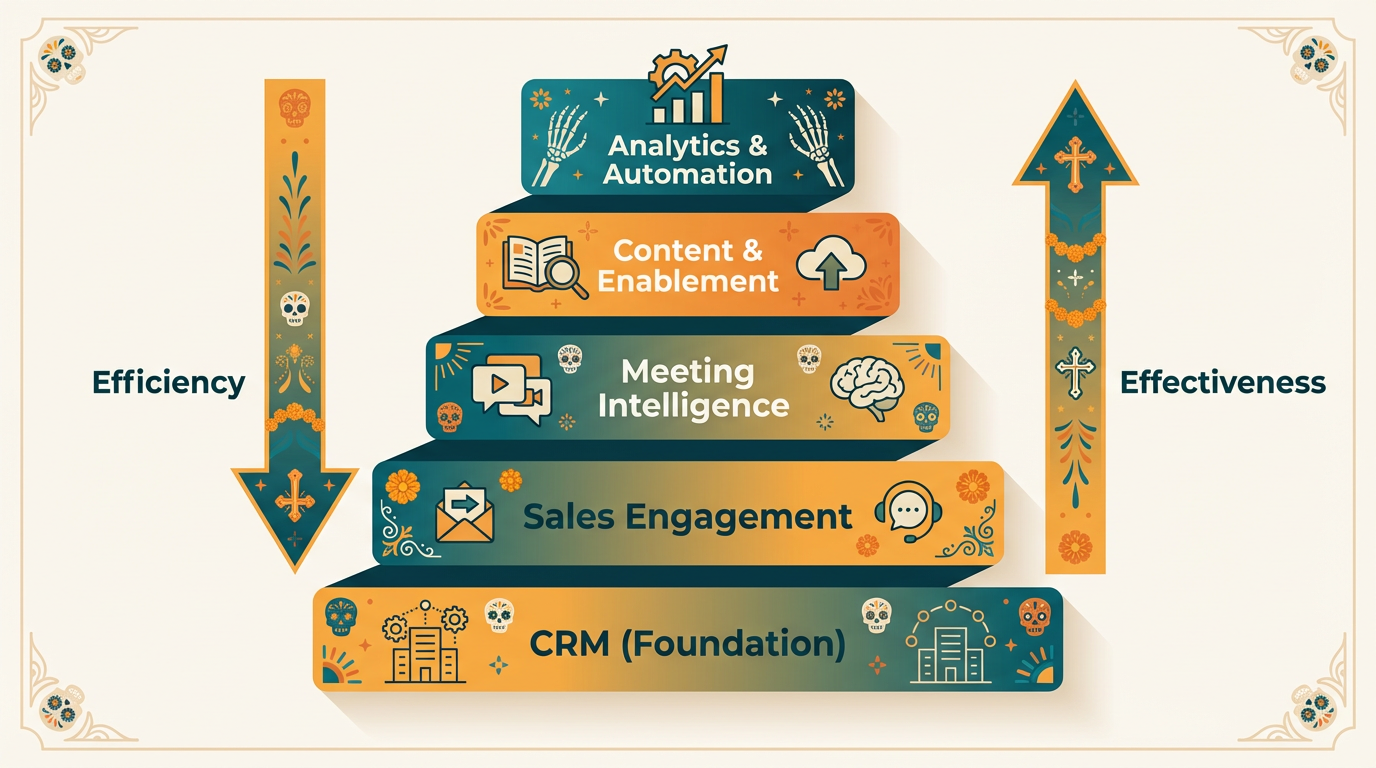
As you can see, every tool should serve one of two main goals: making your team more efficient (doing things faster) or more effective (doing the right things, better).
Let's break down the core layers that make this happen.
Layer 1: The CRM as Your Central Hub
The Customer Relationship Management (CRM) system is the absolute, non-negotiable foundation of any sales stack. It's the central nervous system for your entire sales operation, holding every piece of customer data you can imagine—contact info, communication logs, deal stages, pipeline value, you name it.
Without a solid CRM, your data is a mess, reporting is a nightmare, and none of your other tools have a single source of truth to connect to. It's the definitive record of every customer relationship.
- What it does: Centralizes all customer and prospect data, tracks every interaction, manages the sales pipeline, and acts as the single source of truth for reporting.
- Big players: Salesforce, HubSpot, Zoho CRM.
- The bottom line: A well-kept CRM ensures nothing ever falls through the cracks and gives leadership a clear, real-time pulse on the business.
Layer 2: Sales Engagement and Communication
If the CRM is where you store information, sales engagement platforms are where the action happens. These are the tools that help reps execute their outreach strategies consistently and at scale. They handle things like email sequencing, automated follow-ups, and tracking engagement to see which messages are actually landing.
This layer is what turns a static list of prospects into a pipeline of meaningful conversations. It's where your reps live day-to-day.
Your CRM holds the 'who' and the 'what,' but your engagement platform drives the 'how' and the 'when' of your sales communication. It operationalizes your outreach strategy at scale.
For example, a rep can use an engagement platform to send a five-step email sequence to 50 new prospects in the time it would take to manually email just a handful. This layer also includes the tools for direct interaction, like dialers and video conferencing software.
Layer 3: Meeting and Call Intelligence
Think about all the valuable information shared in a sales call. Most of it disappears the second the call ends. Meeting and call intelligence tools are here to fix that. They record, transcribe, and analyze sales calls, using AI to pinpoint keywords, track talk-to-listen ratios, and highlight coachable moments.
This layer turns every conversation into a learning asset. It's like having game film for your sales team.
- What it does: Records and analyzes sales conversations, provides data-driven coaching insights, identifies what top performers are doing differently, and builds a searchable library of customer interactions.
- Big players: Gong, Chorus.ai, Fathom.
- The bottom line: Managers can give specific, evidence-based feedback instead of relying on gut feelings. New hires can also get up to speed way faster by listening to what a great call actually sounds like.
Layer 4: Content and Enablement Platforms
Sales reps waste a shocking amount of time just trying to find the right content to send to a prospect. A content and enablement platform solves this by creating a central library for all your sales collateral—case studies, one-pagers, presentations, and pricing sheets.
Even better, the more advanced platforms can intelligently suggest the most effective piece of content for a specific deal stage or buyer persona. This layer makes sure every rep has the best-performing material right when they need it, killing the "I can't find that PDF" problem for good.
Tools like Distribute are pushing this even further with AI-powered digital sales rooms. Instead of just emailing attachments, reps can package all the relevant content into a single, professional, and trackable microsite. This not only makes life easier for the buyer but also gives you deep analytics on who viewed what and for how long. That's the kind of insight that helps reps tailor their follow-up and close deals faster.
Layer 5: Analytics and Automation
Finally, you need a layer that ties everything together and makes sense of all the data. Analytics tools pull information from your CRM, engagement platforms, and other sources to build dashboards that visualize performance. They help you track key metrics, forecast revenue, and spot bottlenecks in your process before they become major problems.
Automation and integration platforms are the connective tissue of your stack. Tools like Zapier create workflows that automatically pass data between systems, which cuts out tedious manual entry and keeps everything in sync. For instance, you could set up a rule that automatically adds a new web lead to your CRM and kicks off a specific sales engagement sequence.
This is the layer that makes your sales tech stack more than just a collection of tools—it turns it into a cohesive, intelligent system.
How to Architect Your Stack for Seamless Integration
Knowing the different layers of a sales tech stack is one thing. Making them all work together? That's a completely different ballgame. A poorly architected stack isn't a system—it's a liability. It creates frustrating data silos, confuses your reps, and ultimately leaks revenue.
The secret isn't just buying more tools. It's about designing a thoughtful, cohesive architecture from the ground up. You need a strategic blueprint, not a shopping list. Otherwise, you just end up with a pile of expensive software that complicates more than it helps.
The cost of this disorganization is staggering. In fact, complex and disconnected tech is a primary reason for data silos that waste an average of 12 hours per employee every week. These fragmented systems can also lead to revenue leakage of up to 5% of annual EBITDA, and a shocking 79% of leads fail to convert because of clumsy handoffs between tools.
Start with Strategy, Not Software
The most common mistake I see is teams starting the conversation with, "What software should we buy?" The right question is, "What are we actually trying to achieve?" Before you even look at a single product demo, your architecture plan has to be anchored to clear business goals and your real-world sales process.
First things first: map out your entire sales process, from the first touch to the final close. Identify every single touchpoint, key activity, and handoff between team members. This map is your guide—it shows you what your team actually needs and pinpoints the exact bottlenecks where technology could make a real difference.
This approach ensures you buy tools to solve problems you actually have, not just because they have a flashy feature list. A tool that doesn't fit your workflow will always feel like it's fighting your team, which just leads to low adoption and wasted money.
Establish a Single Source of Truth
A truly seamless sales tech stack needs a gravitational center—a single source of truth that all other tools orbit around. For nearly every sales organization, this is your Customer Relationship Management (CRM) system. Your CRM has to be the undisputed, definitive record for all customer data and interactions. No exceptions.
Every tool you add must either feed data into the CRM or pull data from it to do its job. If a tool creates its own isolated dataset, it's breaking your architecture and creating a new silo.
This principle is non-negotiable. When your CRM is the central hub, reps don't have to waste time hunting for information across five different platforms. All customer history, conversations, and deal statuses live in one place, creating clarity and consistency for the entire team.
Prioritize Native and API-First Integrations
With your CRM as the foundation, the next step is connecting your other tools. The goal is to create an automated, two-way flow of information that kills manual data entry and keeps your entire system in sync. There are two main ways to get this done.
1. Native Integrations: These are the pre-built connections that software vendors offer right out of the box. For example, your sales engagement platform like Salesloft might have a native integration with your CRM that automatically logs every email and call to the right contact record. These are almost always the easiest and most reliable connections to set up.
2. Integration Platforms (iPaaS): Sometimes, the tools you need don't have a native integration. That's where platforms like Zapier or Workato come in. They act as a universal translator, letting you build custom "if this, then that" workflows between almost any two cloud-based apps. This turns static data into powerful automated actions.
By prioritizing tools that connect easily, you build a resilient and efficient sales tech stack.
Example Sales Stacks for Different Business Needs
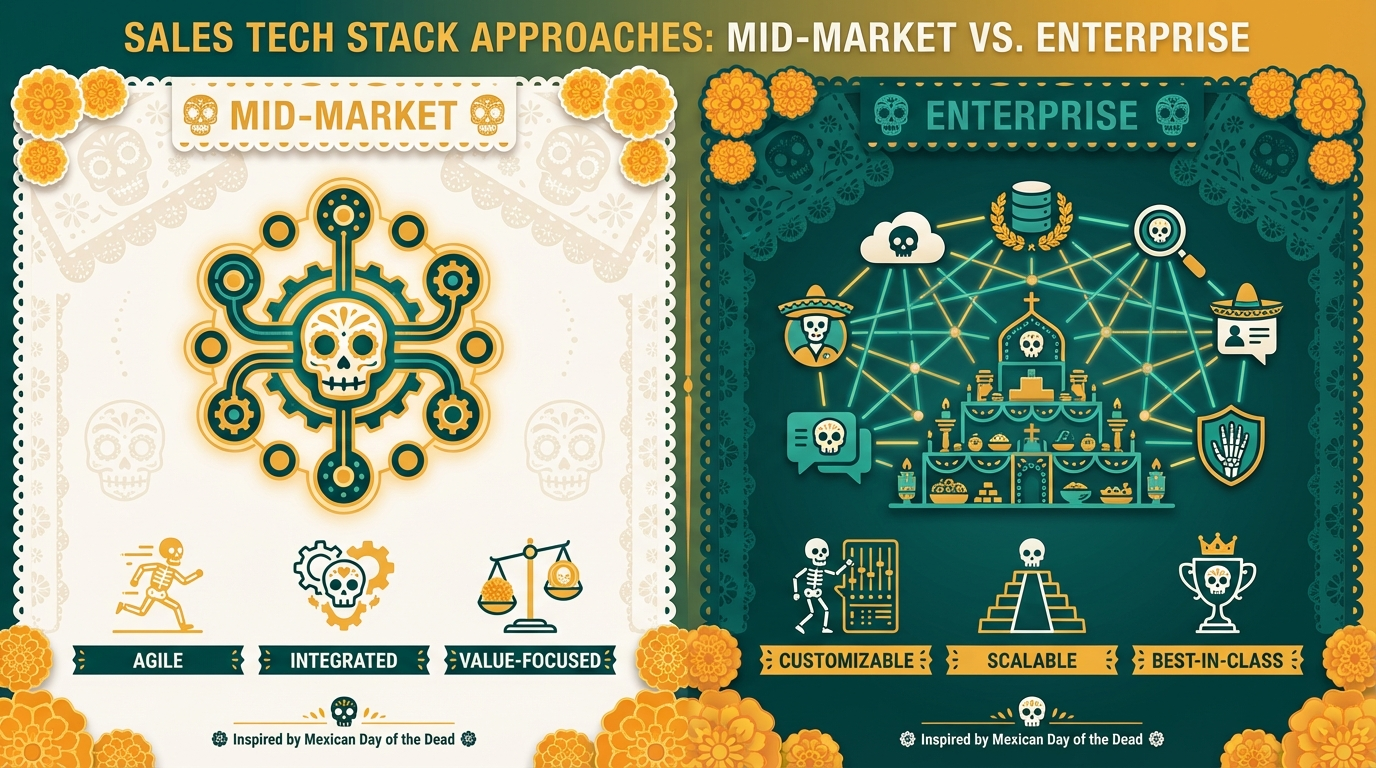
Theory is one thing, but seeing a sales tech stack in the wild is where it all starts to make sense. A stack built for a scrappy, 100-person company just won't work for a 10,000-employee global giant. The right tools really come down to your team's size, how you sell, and of course, your budget.
Let's walk through two practical examples. First, we'll look at a mid-market stack that's all about getting great value from tools that play nicely together. Then, we'll break down an enterprise stack built for deep customization and serious scale, using a mix of specialized, best-in-class software.
These blueprints should give you a feel for the thinking behind each choice, so you can apply that same logic to your own stack.
The Agile Mid-Market Sales Stack
Mid-market companies, usually in the 50-500 employee range, live and breathe agility. Their sales processes are fluid, and they need tools that their teams can pick up quickly and that show a fast return. The name of the game is integration and value for money—no one has time for the complexity and price tag of enterprise software.
The guiding principle is often to find an all-in-one platform that handles most of what you need. This cuts down on vendor management, makes training way simpler, and keeps your data clean without needing a team of engineers to build custom integrations.
A typical mid-market sales stack might include:
- CRM and Engagement: A unified platform like HubSpot Sales Hub or a tightly bundled Zoho CRM Plus. These pack CRM, email sequencing, lead scoring, and reporting into one neat package.
- Meeting Intelligence: A lightweight tool like Fathom or Grain. These are often free or low-cost and give you great recording and transcription without the heavy-duty analytics of enterprise platforms.
- Content and Follow-Up: This is a perfect spot for an AI-powered digital sales room like Distribute. It lets reps spin up personalized, trackable deal rooms in seconds, putting demos, case studies, and proposals all in one place. It makes life easier for the buyer and gives reps incredible insight into what content is actually being viewed.
- Automation: Most of this is handled by the CRM's built-in workflows, but for everything else, a simple connector like Zapier can link outside tools like accounting or project management software.
The philosophy for a mid-market stack is simple: achieve efficiency through simplicity. The goal is to give a smaller team powerful tools that work together right out of the box, freeing them up to spend more time selling.
The Powerful Enterprise Sales Stack
Enterprise organizations are playing a completely different game. We're talking about complex global sales teams, huge product catalogs, and strict security and compliance rules. For them, the priority is customization, scalability, and deep analytical power. They tend to pick the absolute best tool for each specific job and then invest heavily in making them all talk to each other.
An enterprise stack is engineered to handle massive amounts of data and support highly specialized roles within the sales org. This approach provides unmatched power, but it comes with a hefty price tag and a lot of complexity.
For instance, a classic enterprise combo like Salesforce, Pardot, and LinkedIn Ads has a 19.8% adoption rate in firms with over 500 employees. This kind of setup can run anywhere from $120,000 to $300,000 a year. On the flip side, some studies have shown unified platforms like HubSpot can help users get 129% more leads and close 36% more deals in a year, mainly by avoiding the data silos that often plague fragmented stacks.
Comparison of Mid-Market vs. Enterprise Sales Stacks
This table breaks down the tool choices and strategic thinking for each market segment across the core layers of a sales stack.
| Stack Layer | Mid-Market Example | Enterprise Example | | :--- | :--- | :--- | | CRM | HubSpot Sales Hub | Salesforce Sales Cloud | | Sales Engagement | Native features within the CRM (e.g., HubSpot Sequences) | Salesloft or Outreach | | Meeting Intelligence | Fathom or Grain | Gong or Chorus.ai | | Content & Enablement | Distribute (for Digital Sales Rooms and follow-up) | Highspot or Seismic | | Analytics & Forecasting | Built-in CRM reporting and dashboards | Clari or another dedicated revenue intelligence tool | | Integrations | Zapier for simple point-to-point connections | Custom API integrations, iPaaS platforms like MuleSoft |
As you can see, there's no single right answer. The best sales tech stack is one that's carefully designed to support your specific business goals, sales process, and team structure. What works for a startup will hold back an enterprise, and vice-versa.
How AI Tools Are Reshaping the Modern Sales Stack

The next big shift in sales technology is already here, and it's all about artificial intelligence. AI is moving from a background helper to a strategic partner for every sales team. We're not just talking about doing things faster anymore; this is about doing things smarter.
AI tools are being woven into every part of the modern sales stack. They're analyzing conversations, predicting what buyers will do next, and giving reps real-time, data-backed advice. This change is turning sales from a reactive game into a proactive, intelligent system that gives teams a massive edge.
Moving Beyond Automation to Intelligence
For a long time, sales tech was all about automating the boring stuff—sending follow-up emails, logging calls, and the like. That was helpful, but it was just scratching the surface. The new wave of AI-powered tools offers something far more powerful: actual intelligence.
Instead of just recording a sales call, AI can now listen in, analyze the conversation, and pull out key objections, successful talking points, and even the buyer's mood. This gives sales managers incredible coaching material and helps reps tweak their pitch based on what truly resonates.
Intelligent Follow-Up and Digital Sales Rooms
One of the places AI is making the biggest splash is in the post-call follow-up. This is a critical stage where a huge number of deals lose steam because of slow replies or messy communication. AI is completely changing how this works.
Modern AI platforms are no longer just nice-to-have add-ons. They are becoming a core, essential layer of the sales tech stack that shortens sales cycles by making the buying journey personal and painless.
Tools like Distribute are at the forefront of this change, creating AI-powered digital sales rooms. Once a call ends, the platform instantly spins up a shared, trackable deal page. This space holds everything: the call summary, key action items, and all the content you shared, like proposals and case studies.
- For your buyer: They get one clean, professional link with everything they need. No more digging through email chains for that one attachment.
- For your sales rep: They get hours back that were once spent on manual follow-up. Plus, they get incredible insights into what content the buyer is actually looking at.
This smart approach keeps the deal moving and makes sure every touchpoint counts.
The Competitive Edge of an AI-Infused Stack
Building AI into your sales tech stack isn't just a trend—it's a necessity to stay in the game. Teams that adopt these tools can simply move faster, get a much deeper understanding of their buyers, and deliver a better customer experience from start to finish.
AI lets reps focus on what they do best: selling. It takes care of the administrative headache and provides guidance right when they need it. From drafting a personalized email to flagging a deal that's about to go cold, AI works like a co-pilot, helping your team close more business. A stack without this intelligence is quickly becoming a thing of the past.
Measuring the Real ROI of Your Sales Technology
So you've invested in a powerful sales tech stack. That's a big move, but the real test is proving it was worth it. How do you show that your new software isn't just another line item on the expense report, but a genuine revenue driver? The answer goes way beyond a simple cost-versus-savings calculation.
To get to the heart of your return on investment (ROI), you need a practical way to connect your tech directly to what matters: business results. This means tracking the right key performance indicators (KPIs) that show how your stack is actually changing the game across the entire sales motion.
Moving Beyond Cost to Tangible Impact
Everyone knows the basic ROI formula: (Gain from Investment - Cost of Investment) / Cost of Investment. The tricky part is always the "Gain from Investment." It's not just about the money you save; it's about the new value and opportunities you create.
To get the full story, you have to look at both hard numbers and the softer, qualitative shifts.
- Sales Cycle Length: Is your tech helping reps push deals through the pipeline faster? A shorter sales cycle means cash in the bank sooner and a more agile team.
- Lead-to-Opportunity Conversion Rate: Are more of your initial leads actually turning into qualified opportunities? Good tools should help reps zero in on the right prospects and engage them more effectively.
- Average Deal Size: Is your stack empowering reps to upsell or cross-sell? Tools like digital sales rooms can showcase value much more clearly, which often leads to bigger contract values.
- Quota Attainment: What percentage of your team is hitting their sales targets? A well-built stack should directly help more reps not just hit, but blow past their quota.
The Critical Metric of User Adoption
One of the most overlooked—and most important—pieces of the ROI puzzle is user adoption. It's a simple, brutal truth: if your sales team doesn't use the software, you get zero return. Expensive shelfware is one of the fastest ways to absolutely torch the ROI of any tech investment.
Measuring adoption isn't just about counting logins. It's about figuring out if your team is using the tool's key features in a way that actually changes how they work for the better.
This is why you have to get granular with usage patterns. Are reps actually using the email sequencing feature? Are they spinning up digital sales rooms for their most important deals? If adoption is low, it's usually a symptom of a deeper problem—the tool might be a pain to use, badly integrated, or just not solving a real-world problem for your team.
A Practical Framework for Proving Value
To tie everything together, you need a straightforward way to calculate and present the ROI of your stack. This not only justifies what you're already spending but also builds a rock-solid case for future investments.
- Establish a Baseline: Before you roll out a new tool, document where you are right now. What's your current average sales cycle, conversion rate, and quota attainment?
- Track Post-Implementation Metrics: After the new tool is live and people are actually using it, track those same KPIs over a specific period, like one or two sales quarters.
- Calculate the Financial Impact: Now, turn those improvements into dollars and cents. For example, a 10% reduction in a 90-day sales cycle frees up a significant amount of rep capacity, and that time has a clear dollar value.
This data-first approach is how you turn your tech stack from a perceived expense into a proven strategic asset.
Frequently Asked Questions
Putting together a sales tech stack that actually works is bound to bring up some tough questions. Here are some straightforward answers to the things sales leaders and reps wrestle with most.
How Many Tools Should Be in My Sales Tech Stack?
There's no magic number here. The goal isn't to collect as much software as possible—it's to have the right tools working together smoothly.
While the average sales team uses around eight different tools, many are just paying for features they already have in another platform. Instead of aiming for a specific number, make sure you have your core bases covered.
A great starting point usually includes:
- A solid CRM to act as your home base.
- An engagement platform for outreach.
- An analytics tool to see what's working.
- A content/enablement solution to arm your reps.
Only add something new when you spot a genuine gap in your process. A lean stack that solves real problems will always beat a bloated one full of software nobody uses.
How Do I Get My Sales Team to Adopt New Tools?
Getting your team to actually use the new software is the single biggest hurdle to getting a return on your investment. The best tool in the world is just a waste of money if your reps won't touch it.
The secret? Show them how it helps them close more deals.
Bring your top reps into the buying process early. If they feel a sense of ownership and can see how a tool solves a problem they face every day, they'll become its biggest advocates. After that, focus on continuous training, not just a one-and-done demo.
Here's the key: leadership has to be on board. When sales managers actively use the new tool in pipeline reviews and coaching sessions, it signals to everyone that this is the new way of doing things. It's no longer optional.
What Is the First Tool I Should Invest In?
For almost any sales team, the first and most important investment should be a Customer Relationship Management (CRM) system.
Think of your CRM as the central nervous system for your entire sales operation. It's the foundation you build everything else on. It's your single source of truth for customer data, conversation history, and deal status. Without it, data gets scattered, follow-ups get missed, and forecasting becomes a guessing game.
Start with a CRM that fits your needs today but gives you room to grow.
Ready to shorten your sales cycle with AI-powered follow-ups? Distribute turns every customer call into a trackable digital sales room that keeps deals moving forward. Start your free 7-day trial and see the difference.
Distribute Team
Content Specialist at Distribute. Exploring the intersection of AI, sales, and buyer enablement.
Related Articles
A Guide to Digital Sales Room Software and How It Works
A digital sales room cuts through the noise of scattered emails and links. It's a private, branded online hub for each deal, giving your buyer one place to find everything they need.
12 Best AI Powered Sales Tools to Boost Revenue in 2025
Your sales team is spending too much time on tasks that don't involve selling. These AI powered sales tools shift focus back to what reps do best: building relationships and closing deals.
Mastering Sales Process Automation Software: The Complete Guide
Your sales team is spending less than a third of their time actually selling. Sales process automation software flips that ratio, eliminating busywork so reps can focus on what they do best: closing deals.